Speech Therapy for a Child With Cochlear Implant
At Child Development Center (CDC) in Dubai, we work with families navigating one of the most hopeful yet challenging journeys in pediatric care, raising a child with hearing loss who has received a cochlear implant. The implant itself is a medical milestone, but what follows it determines everything.
In our clinical experience, the most common question parents ask after activation is this: “My child has the implant, so why isn’t language coming naturally?”
The answer lies in understanding how the brain learns to interpret an entirely new sound signal and how speech therapy for a child with cochlear implant is the structured process that makes spoken language possible.
What is a Cochlear Implant?
A cochlear implant is an electronic device placed through surgery that bypasses damaged parts of the inner ear and connects directly with the auditory nerve. Unlike a hearing aid that simply amplifies sound, a cochlear implant converts sound into electrical signals that the brain must learn to interpret as meaningful input.
The device works through two key components:
- Internal implant – surgically placed behind the ear during a procedure typically lasting 2–3 hours
- External sound processor – worn on the scalp, it captures sound and sends it to the internal device
Together, they deliver sound to the auditory nerve, but the brain still has to be trained to understand what it receives. That training is the work of speech therapy.
What causes hearing loss that leads to Cochlear Implantation?
Hearing loss serious enough to warrant a cochlear implant doesn’t always have one clear cause. In our experience at Child Development Center (CDC), families often come in having been through months of testing before reaching this point. The most common causes include:
- Genetic conditions are responsible for over 50% of congenital hearing loss cases worldwide
- Prenatal infections – particularly cytomegalovirus (CMV), which remains one of the leading non-genetic causes
- Premature birth or oxygen deprivation during delivery
- Infectious diseases such as meningitis or severe ear infections in early childhood
- Ototoxic medications administered during neonatal intensive care
- Progressive hearing conditions that worsen over time despite hearing aid use
According to the World Health Organization, approximately 34 million children worldwide live with disabling hearing loss. Early identification and timely intervention remain the most important factors in improving long-term speech and language outcomes.
Who is a candidate for a Cochlear Implant?
A cochlear implant is not automatically the right path for every child with hearing loss. Getting evaluated is a thorough process that typically calls on an audiologist, ENT surgeon, speech-language pathologist, and developmental specialist to work together. A child is generally considered a candidate when they meet the following criteria:
- Bilateral severe to profound sensorineural hearing loss confirmed on audiological testing
- Limited or no benefit from appropriately fitted hearing aids after a trial period
- No medical contraindications to surgery
- A family that is committed to post-implant rehabilitation and therapy
Most centers recommend implantation as early as possible, as young as 9 months of age depending on the FDA guidelines and recommendations, to take full advantage of the brain’s neuroplasticity. That said, older children and even adults can still benefit; the timeline just looks different.
Why does a child with a Cochlear Implant need speech therapy?
This is the question at the heart of everything. Parents sometimes assume that once the implant is activated, speech and language will follow naturally there will be no speech delay. In reality, the device delivers sound, but the brain has never processed sound this way before. It needs to be taught.
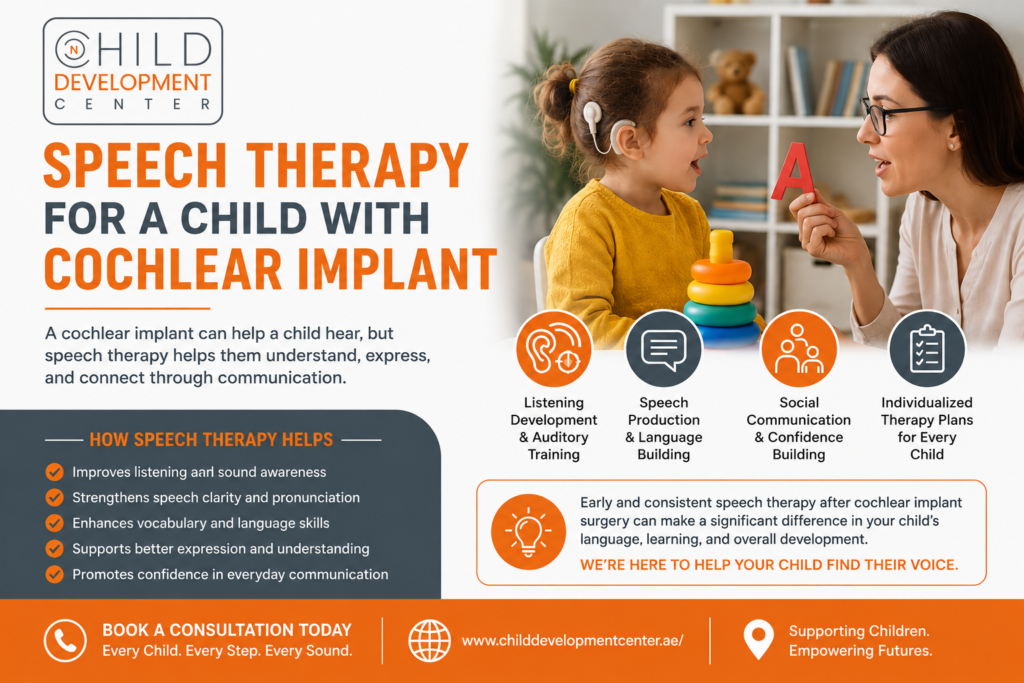
Speech therapy for a child with cochlear implant include several skills that are practiced progressively and simultaneously:
- Trains the brain to detect, recognize, and assign meaning to sound
- Builds the connection between what the child hears and the words they produce
- Develops listening skills in progressively challenging environments
- Guides the child from single-word responses to full conversational language
- Equips parents with strategies to support language learning at home every day
What are the key Cochlear Implant speech therapy techniques used in practice?
At Child Development Center (CDC), no two therapy plans look exactly alike. Our speech-language pathologists assess each child individually and select approaches based on several factors such as age at implantation, residual hearing, cognitive profile, and how the family can participate. The (re)habilitation approach with the strongest clinical evidence is:
Auditory-Verbal Therapy (AVT): AVT is the most widely used approach globally for children with cochlear implants. It focuses entirely on developing listening as the primary channel for spoken language.
Other approaches include Auditory-Oral Therapy: This approach shares AVT’s spoken language goals but incorporates visual cues such as lip reading alongside listening. For children implanted later, or those who find it helpful to receive input in more than one way during the early adjustment period, this tends to work really well.
The Auditory Training Hierarchy that therapists work through involves four structured levels of auditory skills:
- Detection – is there a sound present?
- Discrimination – are these two sounds the same or different?
- Identification – what is this sound or word?
- Comprehension – what does it mean in context?
It mirrors the way the brain naturally develops auditory comprehension, whilst giving therapists a straightforward framework to follow when tracking progress.
When a child’s auditory skills begin to grow, therapy starts to move in a new direction, tackling bigger language goals like vocabulary building, sentence structure, storytelling, and the conversational skills that are so important for school and social life.
How long does speech therapy take after Cochlear Implantation?
There is no single answer to this, but the following table offers a realistic general roadmap:
Stage | Approximate Timeframe | Therapy Focus | Expected Milestones |
Early auditory awareness | 0–3 months post-activation | Sound awareness, detection, and device tolerance | Responds consistently to sound; tolerates the processor all day |
Auditory discrimination | 3–9 months | Differentiating sounds, voices, and environmental noise | Turns to name; recognizes familiar voices and simple words |
Language building | 9 months–2 years | Vocabulary, two-word phrases, sentence structure | 50+ words; simple requests; responds to questions |
Conversational & academic language | 2–5+ years | Complex sentences, narrative, and phonological literacy | Age-appropriate conversation; school readiness |
A child implanted at 12 months with consistent therapy and strong family participation may reach conversational milestones within 2 to 3 years of activation. Not every step forward will be straightforward. Plateaus happen, setbacks during illness are par for the course, and experienced therapists are well prepared for all of it.
What role do parents play in speech therapy for a child with Cochlear Implant?
In every outcome study on cochlear implant rehabilitation, one factor rises above all others: parental involvement. Therapy sessions happen a few times a week. Language learning happens every single waking hour.
Here is what active parental participation looks like in practice:
- Narrating daily life – describing what you’re doing as you cook, dress, or drive creates constant, natural language input
- Reinforcing listening moments – pausing after saying something to give the child time to process and respond
- Ensuring consistent device wear – the processor should be on from the moment the child wakes to the moment they sleep
- Attending therapy sessions – not just dropping off, but being present and learning the techniques alongside the child
- Keeping a progress log – noting new words, sounds, or responses between sessions and sharing this with the therapist
That last point is something we encourage every family at Child Development Center (CDC) to do. It takes few minutes and provides clinically invaluable information that directly shapes the next session.
What are the signs that a child may need more intensive support?
Even with regular therapy, some children need a reassessment. It does not mean the therapy has failed; it means the plan needs to evolve.
Watch for these signs:
- Significant slow progress six months after activation
- Consistently favoring visual support over listening, even in quiet environments
- Visible frustration or withdrawal during communication attempts
- Comprehension noticeably lagging behind same-age peers with implants
- Often pulling the processor off or refusing to wear it
- Having trouble following simple instructions even in familiar settings
Why choose Child Development Center for your child's Cochlear Implant journey?
At Child Development Center (CDC), families work with specialists who understand hearing loss not just clinically, but in terms of what it means for a child’s daily life, confidence, and future.
Our cochlear implant rehabilitation program is led by Sabine EL Deek, a Pediatric Speech & Language Therapist with over 18 years of experience supporting children who are deaf and hard of hearing. She holds a degree in Speech and Language Therapy from the Lebanese University in Beirut, and is currently pursuing her LSLS Certificate AVT® designation through the AG Bell Academy, one of the most respected credentials in Auditory-Verbal practice worldwide.
Here is what families at CDC can expect:
- Support from newborn through adolescence, no need to change providers as your child grows
- A full continuum of care from candidacy evaluation and pre-implant preparation to long-term post-implant rehabilitation
- A parent-coaching model that sends you home after every session with strategies you can use immediately
- By collaborating closely with schools and nurseries, we make sure consistent support follows your child into every setting.
- ASL intervention and sign language training for families who want or need it
Sabine’s practice is built on one core belief: every child deserves to communicate meaningfully, whether through spoken language, sign language, or both. At CDC, that belief shapes everything we do.
Recent Post
Speech Therapy for a Child With Cochlear Implant
Speech Therapy for a Child With Cochlear Implant At Child Development Center (CDC) in Dubai, we work with families navigating one of the most hopeful yet challenging
How many levels of autism are there?
How Many Levels of Autism are there? Explained simply Autism doesn’t look the same in every child or adult. Some individuals speak fluently but struggle
What Techniques Are Used in Behavioral Therapy for Children?
What Techniques Are Used in Behavioral Therapy for Children Children express their emotions and needs through behavior. But it’s essential to understand it’s not the
Contact Us
The right therapy makes all the difference
Speech therapy for a child with cochlear implant is not supplementary to the device; it is what makes the device meaningful. The technology provides access to sound; skilled, consistent therapy teaches the brain what to do with it. Whether your child was activated last month or has had their implant for over a year, it is never too late to evaluate whether their current rehabilitation is meeting their full potential.
At Child Development Center (CDC), our specialist team across Dubai supports children at every stage of their cochlear implant journey, from activation through school-age communication. We believe every child’s journey is unique, and our therapy is built around that idea.
Contact us today to schedule an appointment
FAQ's
When should speech therapy start after cochlear implantation?
The best time to start therapy is immediately post-activation of the hearing device. It is also strongly recommended to meet with your therapist at the pre-implantation phase to start establishing a baseline of communication strategies along with parental guidance and coaching to better understand the expectations. At CDC, we make sure your therapy is already lined up by the time of your activation appointment, so your child does not have to wait to get started.
How often should a child attend speech therapy?
In the first year, most children do well with one to two sessions per week, though this can change as they progress. Practicing at home with parents every day is just as important throughout the process.
Can a cochlear implant child develop normal speech?
With early implantation, regular therapy, and a supportive family, many children develop speech that is virtually indistinguishable from their hearing peers by school age. The research really does back this up.
Is sign language recommended alongside speech therapy?
It depends on family goals and the chosen therapy approach. At CDC, we guide this decision based on each child’s individual profile, there is no single right answer.
How do I find a qualified cochlear implant speech therapist in Dubai?
Look for a therapist with specific experience in pediatric hearing loss and cochlear implant rehabilitation. Child Development Centre (CDC) offers a coordinated multidisciplinary program covering everything from activation to long-term language development.
About the Author
Written by Child Development Center Editorial Team | Medically Reviewed by Pediatric Neurodevelopment Specialists
- Established in 2013
- 25+ Highly Qualified Specialists & Child Therapists
- Comprehensive Multi-Specialty Neurodevelopmental Departments
- 10,000+ Children and Families Positively Impacted
- International Clinical Frameworks & Modern Diagnostic Tools
Child Development Center (CDC) is a premier, multi-specialty pediatric facility in Dubai dedicated to providing world-class, tech-integrated, and evidence-based care for children with diverse developmental needs.
Featuring a highly collaborative network of experienced pediatric neurologists, child psychologists, speech-language pathologists, occupational therapists, and behavioral interventionists, the center delivers structured, comprehensive support across dedicated clinical divisions.
By implementing rigorous, evidence-based intervention strategies like our signature D.A.R.T. method, CDC ensures the highest standards of safety, accuracy, and personalized therapeutic outcomes.
Our specialized medical and developmental content is thoroughly drafted and systematically reviewed by qualified healthcare professionals and department specialists to preserve scientific integrity, absolute reliability, and parental transparency.
Armed with advanced diagnostic tools, an inclusive modern environment, and a deeply family-centric philosophy, CDC Dubai remains a premier regional authority in early intervention, pediatric therapies, and empowering children to reach their highest potential.
Medical Disclaimer
The content on this page is provided for informational and educational purposes only and does not constitute formal medical advice, diagnosis, or treatment. Always consult a qualified physician, developmental pediatrician, or certified therapist for personalized clinical guidance regarding your child’s health.
Medically reviewed by the Clinical & Neurodevelopmental Department