How Many Levels of Autism are there? Explained simply
Autism doesn’t look the same in every child or adult. Some individuals speak fluently but struggle socially, while others may have limited communication and need daily support.
This wide variation often leads families to ask: how many levels of autism are there, and what do they actually mean?
At Child Development Centre (CDC), specialists frequently guide parents through this confusion, helping them understand how autism is classified and what level of support their child may need.
Modern clinical guidelines categorize Autism Spectrum Disorder into three levels based on support needs. These levels of autism are meant to guide care and support, not to label a person’s capabilities.
Understanding these autism types can help parents recognize symptoms early, seek timely evaluation, and choose the right therapies.
Understanding Autism Spectrum Disorder
Autism Spectrum Disorder (ASD) is a neurodevelopmental condition that affects how a person:
- Communicates
- Interacts socially
- Processes sensory input
- Learns and adapts to change
- Behaves in structured or repetitive ways
Because autism exists on a spectrum, symptoms range from mild to more significant challenges. This is why doctors classify autism into three levels, rather than using older labels.
Children across the spectrum often show signs such as:
- Delayed speech or unusual communication patterns
- Limited eye contact
- Difficulty understanding emotions
- Repetitive movements or routines
- Sensory sensitivities (noise, lights, textures)
- Strong focus on specific interests
- Difficulty with transitions or change
These characteristics vary depending on the types of autism and the level of support required.
How many levels of Autism are there?
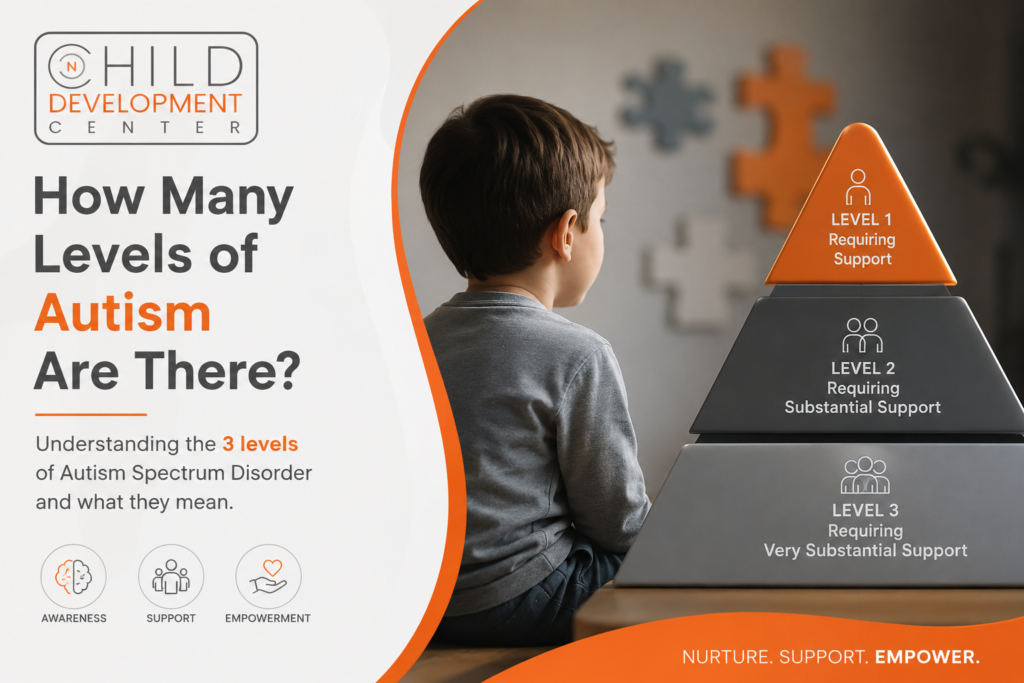
There are three levels of autism, based on how much support a person needs:
- Level 1 – Requires Support
- Level 2 – Requires Substantial Support
- Level 3 – Requires Very Substantial Support
These levels of autism are determined by evaluating:
- Social communication
- Behavioral flexibility
- Independence
- Sensory challenges
- Daily functioning
A person’s level may change over time depending on therapy, development, and environment.
Level 1 Autism – Requires support
Level 1 autism is often less obvious but still affects daily functioning. Individuals typically have average intelligence and can communicate verbally, but social interactions may be challenging.
Key features
- Difficulty initiating conversations
- Trouble understanding social cues
- Literal interpretation of language
- Preference for routines
- Mild sensory sensitivities
- Social anxiety or awkwardness
How it appears in children
- Difficulty interacting and making friends
- Strong interest in specific topics
- Resistance to schedule changes
- Challenges with group activities
- Emotional distress during routine changes
How it appears in adults
- Challenges in social interactions
- Preference for structured environments
- Challenges with multitasking
- Social exhaustion after interactions
People with Level 1 autism often live independently but benefit from structured guidance and social skills training.
Level 2 Autism – Requires substantial support
Level 2 autism involves more noticeable communication differences and repetitive behaviors. In such cases, individuals need consistent support in social and daily activities.
Key characteristics
- Limited verbal communication
- Short or repetitive phrases
- Reduced eye contact
- Difficulty with back-and-forth conversation
- Noticeable repetitive behaviors
Behavioral patterns
- Hand flapping
- Rocking
- Repeating words (echolalia)
- Strict routines
- Distress with change
Daily challenges
- Need for structured schedules
- Social misunderstandings
- Emotional regulation difficulties
- Difficulty adapting to change
Individuals with Level 2 autism often benefit from speech therapy, occupational therapy, and behavioral interventions.
Level 3 Autism – Requires very substantial support
Level 3 autism involves significant communication challenges and dependence on support for daily living.
Common signs
- Minimal or no spoken language
- Limited social interaction
- Severe sensory sensitivities
- Intense repetitive behaviors
- Strong resistance to change
- Difficulty with daily tasks
Communication differences
- Uses gestures instead of speech
- Limited response to social cues
- Difficulty expressing needs
- May use assistive communication devices
Support needs
- Daily caregiver support
- Structured therapy programs
- Special education services
- Sensory support strategies
Timely intervention and a prompt response to the condition help in planning effective treatment.
Comparison of the 3 levels of Autism
Feature | Level 1 | Level 2 | Level 3 |
Communication | Fluent speech but social difficulty | Limited speech | Minimal or no speech |
Social interaction | Mild challenges | Moderate difficulty | Severe difficulty |
Support needs | Occasional support | Regular structured support | Continuous support |
Repetitive behaviors | Mild | Noticeable | Intense |
Independence | Mostly independent | Partial independence | Dependent on support |
Sensory sensitivity | Mild | Moderate | Severe |
Types of Autism: Older terms vs current classification
In the past, autism was divided into separate diagnostic categories. These types of autism were used to describe different symptom patterns and severity levels. Commonly used terms included:
- Asperger’s Syndrome – People with good cognitive abilities who may find it hard to interpret social cues or maintain conversations.
- Autistic Disorder – More significant challenges in communication, behavior, and social interaction.
- PDD-NOS (Pervasive Developmental Disorder – Not Otherwise Specified) – Individuals with some autism traits that did not fully match other categories.
- Childhood Disintegrative Disorder – A rare condition where children lose previously developed skills after normal early development.
However, clinicians found that these categories often overlapped and created confusion. Many children did not fit neatly into one diagnosis, and symptoms could vary widely.
To improve clarity and consistency, these older autism types are now combined under a single diagnosis: Autism Spectrum Disorder (ASD). Instead of separate labels, doctors now describe autism using three levels, based on the amount of support a person needs.
This modern classification helps:
- Provide a more accurate diagnosis
- Focus on individual support needs
- Create personalized therapy plans
- Avoid confusing or overlapping labels
- Track progress over time
Today, rather than asking which type of autism someone has, clinicians focus on the levels of autism and how to provide the right level of support for communication, behavior, and daily functioning.
What causes Autism?
Autism does not develop due to a single cause. Autism is linked to both genetic and neurological factors.
Possible contributors include:
- Genetic predisposition
- Differences in brain development
- Family history of autism
- Premature birth
- Low birth weight
- Advanced parental age
According to U.S. CDC estimates, approximately 1 in 36 children is diagnosed with autism spectrum disorder, highlighting its growing recognition. |
Autism is not caused by vaccines, poor parenting, or diet.
How are Autism levels diagnosed?
Diagnosis includes a detailed developmental evaluation by specialists such as:
- Developmental pediatricians
- Child psychologists
- Neurologists
- Behavioral therapists
Evaluation typically includes:
- Developmental history
- Behavior observation
- Communication assessment
- Social interaction testing
- Standardized autism screening tools
Doctors then determine:
- Whether autism is present
- Which level of autism applies
- What support is required
Early diagnosis allows early therapy, which improves long-term outcomes.
Treatment options based on Autism levels
Treatment is planned based on individual needs and the level of autism identified.
Behavioral therapy
Applied Behavior Analysis (ABA) helps improve:
- Social skills
- Communication
- Behavior
- Daily functioning
Speech therapy
Focuses on:
- Language development
- Nonverbal communication
- Conversation skills
Occupational therapy
Helps with:
- Sensory processing
- Motor skills
- Daily living activities
Social skills training
Improves:
- Emotional awareness
- Peer interaction
- Communication confidence
Educational support
Includes:
- Individualized education plans (IEP)
- Special classroom support
- Structured learning environments
Starting therapy early and staying consistent can improve communication and independence in daily living.
Practical guidance for parents
If you notice early signs, the following steps may help:
- Track developmental milestones
- Observe speech delays
- Monitor social behavior
- Reduce sensory overload
- Create predictable routines
- Encourage communication
- Seek early screening
Early intervention is crucial to improve outcomes, regardless of the levels of autism.
When should you consult a specialist?
Seek professional evaluation if a child:
- Does not respond to name
- Has delayed speech
- Avoids eye contact
- Shows repetitive movements
- Has sensory sensitivities
- Struggles socially
- Resists routine changes
Early assessment helps determine levels of autism and guides appropriate therapy. At Child Development Centre (CDC), developmental specialists perform structured evaluations to identify autism levels and create personalized intervention plans.
Recent Post

Speech Therapy for a Child With Cochlear Implant
Speech Therapy for a Child With Cochlear Implant At Child Development Center (CDC) in Dubai, we work with families navigating one of the most hopeful yet challenging
How many levels of autism are there?
How Many Levels of Autism are there? Explained simply Autism doesn’t look the same in every child or adult. Some individuals speak fluently but struggle

What Techniques Are Used in Behavioral Therapy for Children?
What Techniques Are Used in Behavioral Therapy for Children Children express their emotions and needs through behavior. But it’s essential to understand it’s not the
Contact Us
Guiding your child through the Autism spectrum
Understanding the levels of autism helps families make informed decisions about care and therapy. Autism is a spectrum, and each individual’s strengths and challenges are unique. The three levels, requiring support, substantial support, and very substantial support, guide clinicians in planning personalized treatment.
Recognizing autism early, seeking evaluation, and starting therapy can improve communication, learning, and independence. At Child Development Centre (CDC), early screening, developmental assessment, and therapy programs are designed to support children at every stage of autism.
If you’re wondering how many levels of autism are there, book your consultation at the Child Development Centre (CDC) for expert guidance.
FAQ's
1. How many levels of autism are there?
There are three levels of autism: Level 1 (requires support), Level 2 (requires substantial support), and Level 3 (requires very substantial support).
2. What are the levels of autism based on?
The levels are based on communication ability, social interaction, behavior patterns, and independence.
3. Can a child move between autism levels?
Yes. With therapy and development, support needs may change, and functioning can improve over time.
4. Is Level 1 autism mild autism?
Level 1 autism requires less support but still affects communication, flexibility, and social interaction.
5. Which level of autism needs the most support?
Level 3 autism requires the highest level of support for communication, behavior, and daily living.